What began as a joyful father‑son outing to celebrate a birthday at a Major League Baseball game turned into an unforgettable story that spread across social media, sparking debate, disappointment, and ultimately a wave of goodwill from both teams involved.
The drama unfolded on September 5, 2025, during the matchup between the Philadelphia Phillies and the Miami Marlins at loanDepot Park in Miami, Florida — and it eventually became much more than just a baseball highlight.
It was the fourth inning of the game — a night that would otherwise be remembered for sterling pitching, enthusiastic fans, and the lively atmosphere typical of a September ballgame.
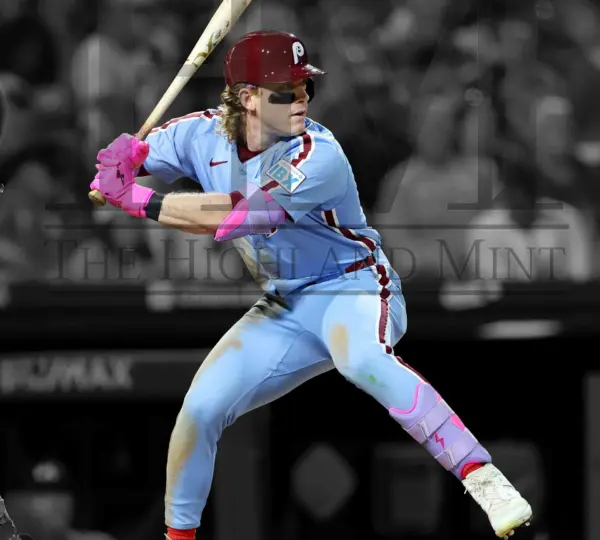
Phillies outfielder Harrison Bader sent a batted ball soaring high and deep into the left‑field stands with a thunderous swing, landing it among eager fans.
In baseball, when a player hits a ball into the stands on the fly for a home run, any spectator who legally catches it gets to keep it — a beloved tradition that makes games special for children and adults alike.
As the ball arced toward the stands, dozens of fans in that section sprang to their feet and rushed forward, arms outstretched in an attempt to secure the prized souvenir.
Amid the scramble, one man — later identified as Drew Feltwell — managed to snag the ball and, with a smile of triumph, walked back a few seats to present it to his young son, Lincoln, who was celebrating his 10th birthday that week.
The father placed the ball in Lincoln’s glove, wrapped him in a warm hug, and shared a moment of pure joy that any parent would recognize.
For many at the game, it was a perfect slice of baseball magic — the kind that makes memories.
When a Nice Moment Turns Strange
What happened next is what made the video go viral. Moments after Lincoln received the baseball, a middle‑aged woman wearing Phillies gear — quickly dubbed by some on social media as “Phillies Karen” — strode over to the family, visibly agitated.
Video clips from multiple angles show the woman approaching Drew and Lincoln and loudly insisting that the ball was actually hers. In the footage, she claims the ball had been “in her hands” before it ended up with the father and son.
The exchange was brief but heated. Witnesses and later commentators noted that the woman was assertive and persistent in her demand, repeatedly telling Drew she believed the ball belonged to her.
After a tense moment, Drew, clearly trying to avoid a public scene and protect his son from an escalating argument, removed the ball from Lincoln’s glove and handed it to the woman.
For many watching, the father’s decision reflected a father’s instinct to keep peace for his child, even at personal cost.
Social Media Reaction and Widespread Outrage
Even before the game had ended, videos of the interaction were circulating on social platforms like X (formerly Twitter) and Reddit, accumulating millions of views.
Fans who saw the clip were quick to react, and many expressed strong criticism — not of the father or son, but of the woman who demanded the ball.
In online discussions, commenters wrestled with questions about tradition, fair play, and how adults should behave at children’s events.
Some described the moment as “taking candy from a baby,” while others speculated on what should or shouldn’t happen at games when disputes over memorabilia arise.
While some speculation about the woman’s identity circulated online, including false rumors about who she might be, there is no confirmed public identification of her and no indication that her personal information should be widely spread or used against her.
Responsible reporting and respect for privacy remain important even when people behave poorly in public moments.
Teams Step In — Turning Disappointment into a Positive Experience
Despite how upsetting it was for Lincoln at the moment, the story didn’t end with a lost baseball and viral anger. Representatives from both the Marlins and the Phillies saw the interaction unfold from the field and took steps to turn the day around for the young fan.
During the game, **Marlins staff members approached the Feltwell family in the stands and presented Lincoln with a goodie bag that included baseballs and other team merchandise.
This small gesture offered an immediate way to soften the blow of the lost home run ball and bring a smile back to the birthday boy’s face.
But the story got even better after the game.
A Signed Bat and a Moment to Remember
Shortly after the final out, the Phillies organization reached out to the Feltwell family and invited them to the clubhouse area.
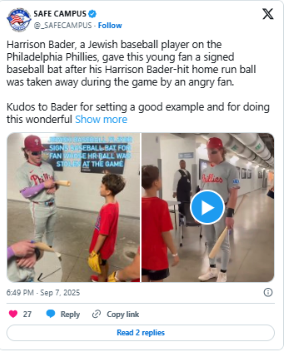
There, Harrison Bader personally greeted Lincoln and presented him with a signed bat — a gift that transformed the story from one of contention to one of generosity and connection.
Photos shared by the Phillies on social media showed Lincoln smiling broadly alongside Bader, holding the bat as proud family members looked on.
The gesture was more than a publicity moment — it was a heartfelt way for the Phillies, and Bader in particular, to acknowledge how meaningful baseball souvenirs can be for young fans and to ensure that Lincoln’s birthday remained memorable for all the right reasons.
Many supporters online praised the team’s handling of the situation, calling it “a class act” and “a perfect example of making things right.”
On social media, posts celebrating Lincoln’s signed bat circulated widely, with many users commenting that the experience may have “made a Phillies fan out of me,” or praising both organizations for doing what they could to help a young fan end the night happy.
Reflections from the Father and Family
In interviews following the game, Lincoln’s father, Drew Feltwell, spoke candidly about both the initial disappointment and the positive outcome.
He said that his intention had simply been to create a special memory for his son’s birthday week, and that seeing Lincoln’s excitement when the ball first landed in his glove had been the highlight of the evening.
Although the moment with the other fan was unexpected, Drew explained that he chose to give up the ball to avoid creating a longer confrontation at the game — particularly in front of his child.
He also expressed gratitude for how the situation was handled afterward by the teams. As he told the local press, while he wished Lincoln had been able to keep the original home run ball, the signed bat and gifts ultimately made the night something Lincoln would remember fondly — a message that resonated with many viewers beyond the stadium stands.
A Broader Conversation About Respect at Sporting Events
The episode sparked a broader conversation about fan etiquette and the culture around collectible items in sports.
In baseball and other spectator sports, there’s an unwritten understanding that a fan who successfully catches a ball belongs to the first person who legally secures it.
Particularly when children are involved, many observers feel strongly that adults should step aside rather than challenge or dispute a ball’s ownership in ways that create stress or conflict.
Commentators on both sides of the issue suggested that teaching respect and kindness — especially to children experiencing a special day like a birthday — is part of what makes live sporting events meaningful.
The Phillies‑Marlins incident highlighted how quickly a happy moment can turn sour, but also how teams and communities can respond with compassion to help restore joy.
How the Moment Ended Up Being a Win for Everyone
By the end of the evening:
-
Lincoln, while momentarily disappointed, walked away with a signed bat from Harrison Bader, a gift that fans his age dream about.
-
The Marlins presented him with a goodie bag of official merchandise, including baseballs and swag, to commemorate the game.
-
The father and son family left with a story — complete with ups and downs — that is now part of baseball lore for fans who watched the video go viral.
-
Social media reactions, while initially critical of the contentious interaction, also showed a wave of support for how the situation was resolved and for the father’s calm handling of the tension.
What might have ended the night on a sour note instead became an opportunity for both teams and a key player to acknowledge how special the game is for families and young fans.
The community responded not with lingering frustration, but with appreciation for the effort to turn an awkward situation to a positive memory.