At some point, most of us have been driving along, approaching an intersection, and spotting a familiar sight—a stop sign. It’s red, octagonal, and instantly recognizable. But what if you came across one that was blue instead? Would you stop? Would you assume it was a mistake? Or would you start questioning everything you know about road signs?
Seeing a blue stop sign can be confusing because it goes against what we’re used to. Stop signs have been red for decades, so a different color immediately stands out. While blue stop signs aren’t common, they do exist in certain places. Their purpose, however, is a bit different from the standard red stop sign we all know.
What Is a Blue Stop Sign?
A blue stop sign functions the same way as a regular stop sign. It tells drivers to come to a complete stop before proceeding. The key difference is that blue stop signs are not issued by the U.S. Department of Transportation and are not legally required on public roads.
In the United States, traffic signs follow strict guidelines set by the Manual on Uniform Traffic Control Devices. This document regulates the shape, color, and meaning of all official road signs, including stop signs. According to these regulations, stop signs must be red with white lettering. A blue stop sign does not meet these official guidelines, which means it is not used for government-regulated traffic control.
Where Can You Find Blue Stop Signs?
Because blue stop signs are not federally recognized, they are typically found on private property rather than public roads. Some common places where they might be installed include:
- Private communities or gated neighborhoods where property owners want to mark intersections.
- Parking lots of businesses or shopping centers to guide traffic flow.
- University campuses that use non-standard signage for aesthetic or branding purposes.
- Industrial sites where companies use custom signs for internal traffic control.
Since blue stop signs are not part of official road regulations, stopping at one is generally not legally required unless local rules dictate otherwise. However, ignoring one in a private community or parking lot could still lead to issues, especially if there are security officers or community enforcement involved.
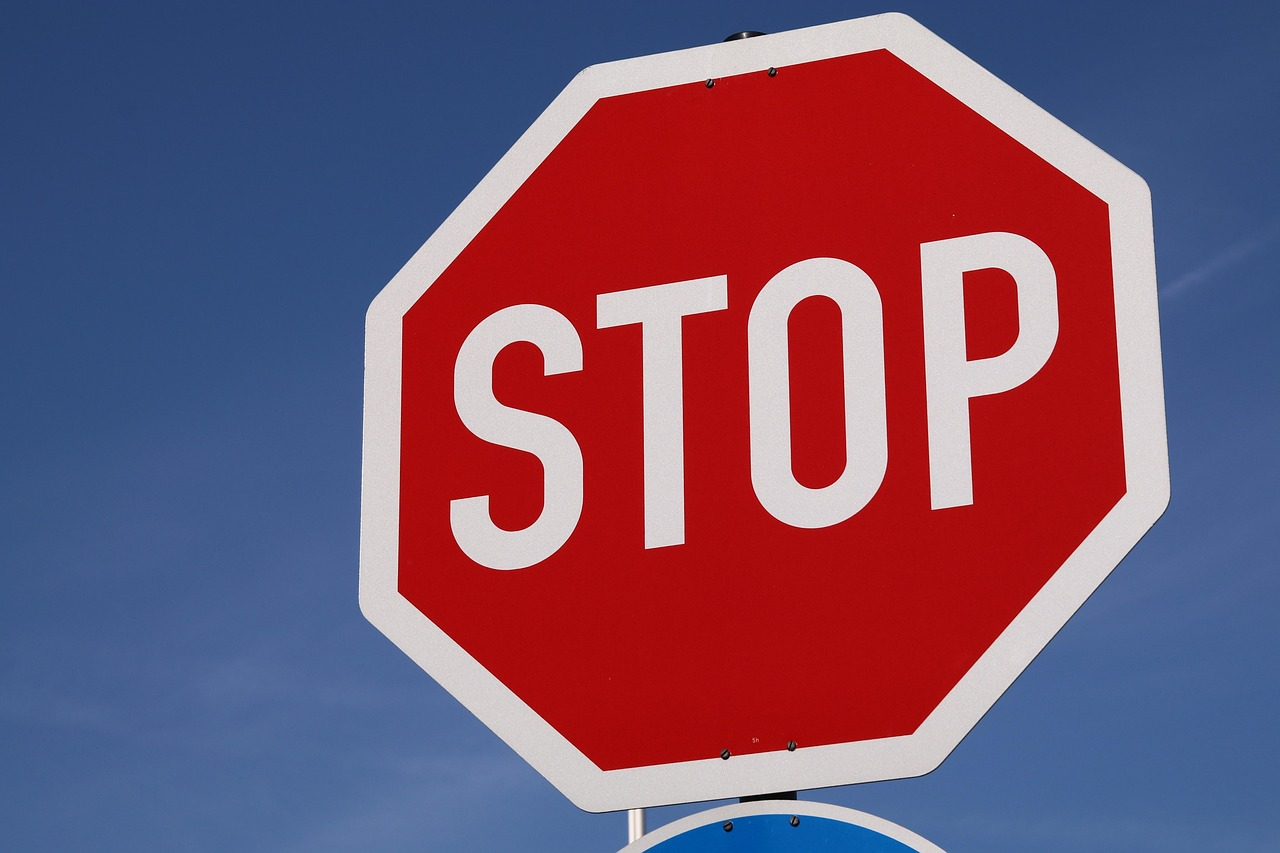
Why Are Stop Signs Typically Red?
Seeing a blue stop sign makes people wonder why stop signs are red in the first place. The answer comes down to visibility, consistency, and history.
Early Stop Signs Weren’t Always Red
Stop signs in the United States weren’t always red. In fact, when stop signs were first introduced in the 1910s, they were yellow with black lettering. At the time, reflective materials weren’t widely available, and yellow was the most visible color both during the day and at night.
By the 1950s, advancements in reflective coatings made red a better option. Red is associated with warnings and prohibitions, making it an ideal color for something as important as a stop sign. In 1954, the United States officially adopted the red stop sign with white lettering, and it has remained the standard ever since.
Color Psychology and Traffic Signs
Traffic sign colors are carefully chosen based on human perception and instinctive responses. Red is universally recognized as a warning color. It grabs attention and signals danger, making it ideal for stop signs and other critical traffic markers like yield signs and do-not-enter signs.
Other traffic sign colors also have specific meanings:
- Blue traffic signs generally indicate services, information, or guidance, such as rest areas, hospitals, and evacuation routes.
- Green signs are used for directions and highway exits.
- Yellow signs warn of hazards or changes in road conditions.
- White and black signs are used for regulatory purposes, such as speed limits.
A blue stop sign goes against these conventions, which is why it is not used on public roads.
Are There Other Unusual Stop Signs?
Blue stop signs aren’t the only unusual stop signs out there. While the classic red stop sign is standard worldwide, some variations exist in different countries and regions.
- Fluorescent yellow stop signs have been seen in a few locations as an experiment to increase visibility.
- Bilingual stop signs are common in areas with large non-English-speaking populations. In Quebec, for example, stop signs say “Arrêt” instead of “Stop.”
- Black-and-white stop signs have been spotted in some private communities that prefer a different aesthetic.
- Flashing LED stop signs are being installed in areas where visibility is a concern, such as dangerous intersections or roads with high-speed traffic.
The blue stop sign is just one example of how some places choose to deviate from the norm for private use or aesthetic reasons.
Should You Stop at a Blue Stop Sign?
If you come across a blue stop sign, the safest choice is to treat it like a regular stop sign, especially if it is in a private community or parking lot. Even though it is not government-regulated, it was likely placed there for a reason.
Ignoring one in a parking lot or private area could still lead to accidents or conflicts with local enforcement. It’s always better to err on the side of caution rather than assume a stop sign doesn’t apply just because it’s blue.
A blue stop sign may seem strange, but it has a purpose, even if it’s not an official traffic control device. These signs are typically used on private property rather than public roads, which is why they don’t follow standard regulations. The classic red stop sign remains the legal and widely recognized standard due to its visibility and association with safety.
If you ever spot a blue stop sign, it’s a good reminder that not all traffic signs are created equal. Whether they follow official guidelines or not, they exist to help control the flow of vehicles and prevent accidents. If in doubt, it’s always best to follow the instructions—regardless of the color.