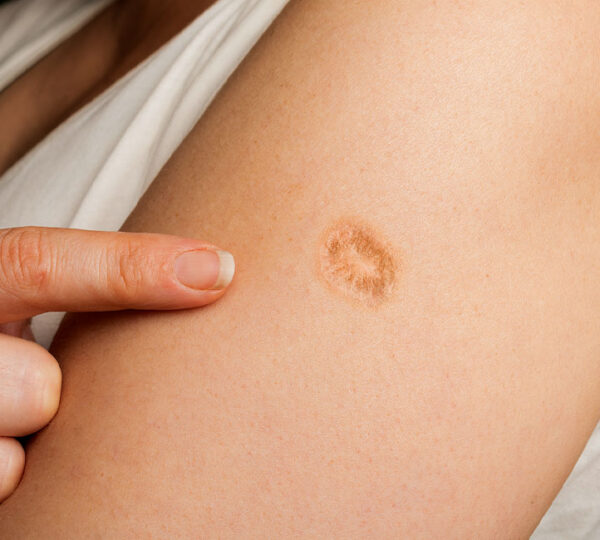
I remember clearly the first time I noticed a distinct scar on my mother’s arm when I was a child, high up near her shoulder in an unusual pattern. It was a ring of small indents around a larger mark that immediately caught my eye.
At the time, I don’t really know why it held my fascination, but I remember staring at it and wondering what had caused such an odd-looking mark to appear on her skin. It was strangely intriguing to young me.
Over many years I forgot my childhood interest in that scar, though the scar itself never went away. It remained exactly where it always was, a quiet reminder of something my young mind once found curious.
I might have asked my mother about the scar when I was small, and she likely told me its origin. But if she did explain, my brain didn’t consider that information crucial enough to hold onto.
That all changed a few summers ago when I was helping an elderly woman off of a train, and I caught sight of that very same scar on her arm, in the exact same place as my mother’s.
With the train about to depart, I didn’t have the chance to ask her about the scar’s origin. Instead, my curiosity brought back the long-forgotten memory, and I immediately called my mother for an explanation.
To my surprise, she told me she had explained the origin to me more than once when I was younger, even if I now couldn’t remember it. She said the scar came from her smallpox vaccination.
Smallpox was a viral infectious disease caused by the variola virus that once afflicted humans far and wide. Before eradication, it spread through populations, causing high fever, rashes, and deep skin lesions.
This deadly disease killed roughly three out of every ten infected victims in major outbreaks, often leaving survivors with disfiguring scars across their body and even blindness in some cases.
The scars left by the infection were sometimes more widespread and deeper than the vaccination scar, haunting survivors long after the acute illness had passed.
The smallpox vaccine, developed in the late 18th century, became the first effective tool to protect people worldwide against this devastating virus.
Vast vaccination campaigns throughout the 20th century dramatically reduced smallpox cases and deaths. By midcentury, widespread immunization campaigns were underway across the United States and other nations.
In fact, thanks to these efforts, smallpox was declared eradicated worldwide in 1980 following the last naturally occurring case in 1977.
Because smallpox no longer circulates in nature, routine vaccination of the general population ended in the United States in 1972.
What remained, though, was the physical legacy of vaccination: a distinctive scar on the upper arm of those who received the vaccine as children.
For decades, every child in the U.S. was vaccinated against smallpox, and most adults who grew up before the early 1970s bear that scar, typically on the upper arm.
Historians have described these scars as a kind of early “vaccine passport” — a visible sign that a person had been immunized against a deadly infectious disease.
Social records from the early 20th century show that public health officials sometimes checked arms for these marks to confirm a person’s vaccination status before allowing access to certain public spaces.
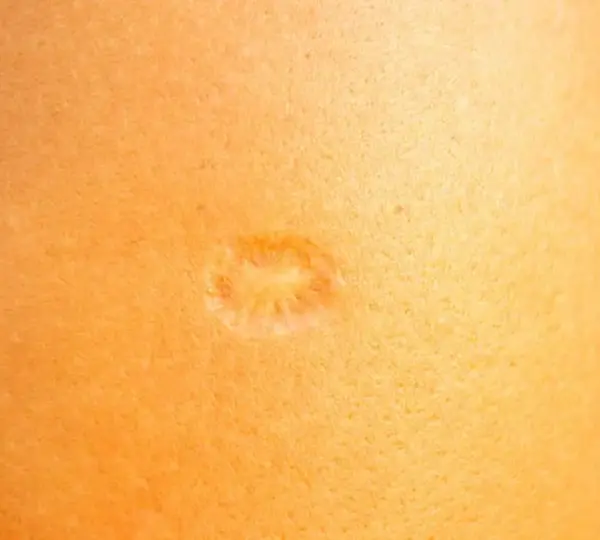
The smallpox vaccine scar’s distinctive appearance can vary slightly among individuals but is usually circular, a bit indented, and smaller than the size of a pencil eraser.
To understand why this scar formed, it helps to know how the vaccine was delivered — very differently from most modern vaccinations.
Rather than a single injection deep into muscle, the smallpox vaccine was given using a bifurcated needle, which has two prongs to hold a tiny droplet of vaccine solution.
The vaccinators dipped this needle into the vaccine and then repeatedly pricked the skin of the upper arm, delivering the vaccine into the dermis — the skin layer just below the surface.

This method was deliberate: it produced a controlled local infection that would stimulate the immune system strongly, giving a reliable immune response to protect against smallpox.
Within a few days of vaccination, a small red bump formed at the site. This bump grew into a fluid-filled blister known as a vesicle, as the modified virus replicated and triggered an immune reaction.
As part of the normal healing process, the blister gradually scabbed over, dried out, and eventually fell off between weeks two and three after vaccination.
What remained was a small, firm, pitted scar — the visible reminder of the immune system’s successful response to the vaccine.
This scar wasn’t harmful, but it was a sign that the body had built up defenses against the dangerous variola virus.
The scar formed because the skin had been intentionally injured and then healed in a concentrated area. Scar tissue regenerates differently from normal skin, leaving a noticeable mark.
Skin fibers in a healed scar grow more uniformly in a single direction, unlike normal skin, which has fibers in various directions, and this structural difference creates a visible mark.
While many people born before 1972 have this vaccination scar, not everyone does — reactions vary by individual immune response and healing.
Some people’s scars faded over time, while others developed slightly larger or smaller marks depending on their skin’s response to injury.
Modern smallpox vaccines still use variations of the same two‑pronged technique when vaccinations are needed for laboratory workers or military personnel.
Today, the vaccine is not part of routine public immunization anywhere because smallpox no longer circulates naturally in the world.
However, public health agencies have stockpiles of smallpox vaccine that could be used if the virus ever re‑emerged either naturally or through biological threat scenarios.
Because the vaccinia virus used in the vaccine is related to the variola virus, it trains the immune system to recognize and fight the real smallpox virus if exposure occurred.
The scar remains as proof that this immune training took place, a testament to one of medicine’s greatest achievements in disease prevention.
Thinking back on my mother’s scar now, I realize it was once so common that nearly everyone of her generation had one.
In fact, seeing that same mark on the elderly woman I helped from the train felt like a bridge across time — a reminder of a shared historical experience.
I wonder how many stories like mine exist, where such a small mark holds a connection to both personal memory and broader medical history.
For many families, smallpox vaccine scars are a reminder of what medical science has achieved, and of the diseases people once feared.
When I think about the fear smallpox once inspired, it’s humbling to realize how far vaccination programs have changed global health for the better.
Smallpox’s eradication stands as one of the most successful public health campaigns in history, made possible through coordinated global vaccination efforts.
The scars left by the vaccine are a symbol of that success, reminders on the arms of those who lived through that era.
Now that I know the history behind that scar on my mother’s arm, every time I see it, I think about the resilience of our immune systems and the power of medical innovation.
That tiny mark carries a story far bigger than I ever imagined as a child, connecting personal memory with global progress in human health.
And while routine vaccination against smallpox has long since stopped, the legacy of those scars remains a quiet, enduring emblem of triumph over one of history’s most fearsome diseases.