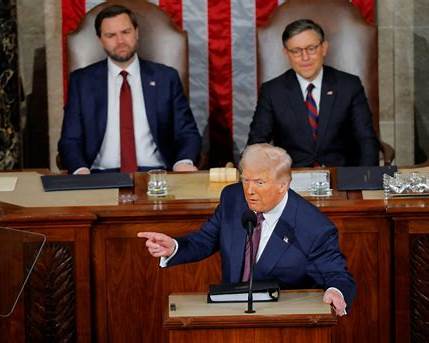
On February 24, 2026, President Donald Trump delivered what would become the longest State of the Union address in U.S. history.
Spanning nearly one hour and 48 minutes, the speech covered a wide range of topics—from economic claims and immigration to foreign policy and technology—but also drew attention for a light‑hearted moment about his wife, Melania Trump, placing her briefly in the national spotlight in an unexpected way.
This address marked Trump’s first State of the Union in his second term and his fourth overall, delivered before a joint session of the 119th United States Congress at the U.S. Capitol in Washington, D.C. It drew significant media coverage, intense political debate, and palpable reactions on both sides of the aisle.
Setting the Stage: A Record‑Setting Address
The 2026 State of the Union began at approximately 9:12 p.m. EST and extended deep into the evening.
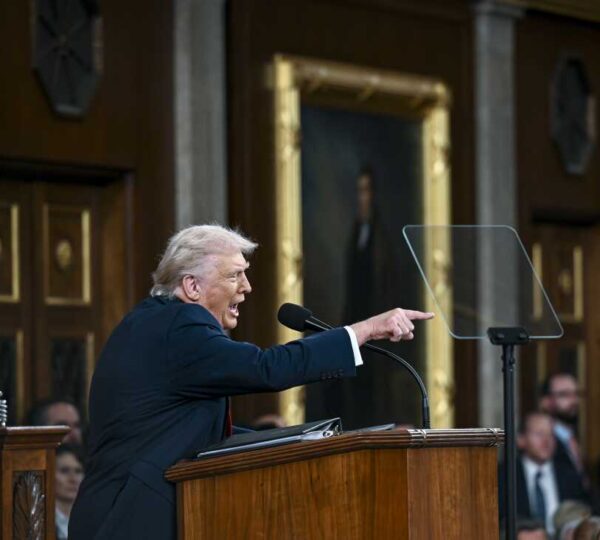
Trump’s marathon speech also eclipsed his own 2025 address, asserting a new modern benchmark for length.
A longer address isn’t inherently unusual—State of the Union speeches often broaden beyond simple policy outlines—but the breadth and depth of Trump’s remarks sparked mixed reactions.
Some supporters celebrated the exhaustive review of his agenda, while critics called segments rambling or unfocused.
Polling released just days after the event showed that reactions to Trump’s address were among the most divisive of any State of the Union this century.
According to a CNN/SSRS poll, while about 64% of viewers rated the speech somewhat positively, only 38% had a very positive view, making it one of Trump’s least popular addresses in modern presidential history.
Even the viewership numbers told a story: preliminary data indicated a decline in audience size compared with both Trump’s 2025 address and other recent State of the Union speeches, suggesting that public engagement may be slipping even as political polarization rises.
Across major broadcast networks, just 27.8 million viewers tuned in, marking a drop of nearly 12% from the previous year’s joint session address.
Themes of the Speech: Economy, Immigration, and National Identity
Like many past State of the Union addresses, the speech served as a platform for Trump to frame his policy priorities and political narrative.
Much of the address focused on what he described as America’s economic comeback, achievements on trade and tariffs, and expanding domestic energy production.
He also touched on immigration enforcement, national security, and foreign policy achievements. Critics, however, claimed that several of Trump’s assertions lacked clear evidence or glossed over complicated realities.
Trump took aim at political opponents—especially Democratic lawmakers—casting them as obstacles to his agenda.
His tone shifted between celebratory and combative, challenging critics and reinforcing partisan divides. At one point, Trump characterized political opposition rhetoric as extreme or disconnected from mainstream voters.
His address framed issues like inflation control, border security, and labor market statistics as defining accomplishments of his first year in office.
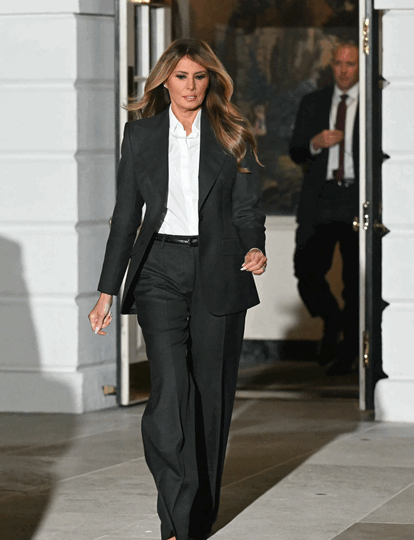
An Unexpected Personal Moment: Melania Trump Takes the Spotlight
While much of the speech was focused on policy and political narratives, one moment stood out for its personal tone and light‑hearted humor.
Trump began by praising Melania’s work over the past year, emphasizing her involvement in issues ranging from foster care initiatives to technology and youth programs.
He highlighted her role in securing federal funding—reported at $30 million—to support the newly launched Melania Trump Foster Youth to Independence Initiative, a program aimed at providing resources and opportunities for foster youth.
In describing her contributions, Trump used a raised, celebratory tone, calling her a “movie star”—a nod to the recent documentary about her life released on a major streaming platform.
While Trump’s specific financial details about the documentary haven’t been officially disclosed by Amazon or the First Lady’s office, the speech referenced her growing public profile outside traditional political roles.
Then came the moment that caught many observers off guard: Trump paused and made a playful remark about Melania’s apparent political appeal.
“It’s a really tremendous thing that happened and she got a lot of bipartisan support. She gets much better bipartisan support than I do. I get none, she gets a lot. Someday you’re going to have to tell me how you did that!”
This remark generated notable buzz because it seemed to contrast Trump’s often combative political image with a humorous acknowledgment that Melania’s initiatives attracted support from both Republicans and Democrats alike—or at least that was the intent.
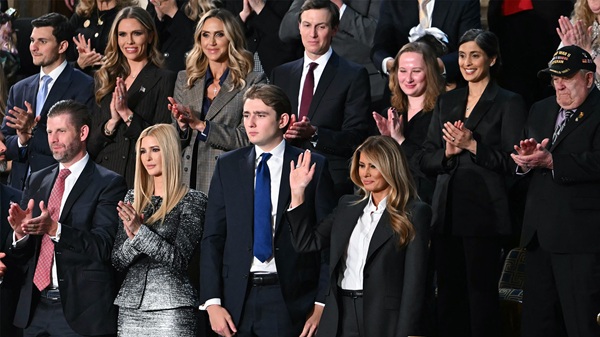
Many commentators saw it as a gentle tease rather than a criticism, treating the comment as part of Trump’s broader rhetorical style.
Melania’s Public Image: Approval Ratings in Context
Despite Trump’s reference to bipartisan support, broader polling suggests that Melania’s national approval remains modest to negative among general voters.
According to a recent YouGov survey, the First Lady’s approval rating stood at ‑16, meaning net more Americans disapproved than approved of her performance or public presence.
That rating is lower than that of the current First Lady of the time before her, Jill Biden (-9), but still slightly better than some politicians like Hillary Clinton (-17) measured in similar polling.
When compared to historic approval figures for former first ladies, Melania’s numbers lag significantly. Several first ladies—including Nancy Reagan (+25), Rosalynn Carter (+32), Lady Bird Johnson (+23), Barbara Bush (+21), Michelle Obama (+21), and Laura Bush (+19)—all posted positive approval ratings during their tenures or beyond.
Melania’s lower polling reflected, in part, the deeply polarized political environment and the mixed reception of her public initiatives.
It’s worth noting that approval ratings for public figures, including first ladies, fluctuate over time and often depend on the broader political climate, media portrayal, and public familiarity with their work.
While Trump’s comments in the State of the Union framed Melania’s initiatives as widely supported, general population approval surveys paint a more nuanced picture.
Reception from Lawmakers and the Public
Reactions from Congress and political observers were, unsurprisingly, mixed. Members of Trump’s Republican Party applauded key sections of the address—especially parts highlighting economic claims and national security achievements.
Some Republican lawmakers praised the speech as forward‑looking and comprehensive, asserting that it laid a foundation for ongoing legislative efforts.
In contrast, Democratic leaders and many commentators criticized aspects of the address for perceived partisanship, repetitive themes, and controversial assertions.
Some raised concerns about the tone of political rhetoric, asserting that certain parts of the speech served to deepen divisions rather than unify the country.
Several Democratic lawmakers also released official responses and public statements emphasizing policy disagreements.
Media and Polling Reactions After the Address
In the hours and days after the event, national polls evaluated public reactions to the address itself. Here are some key insights from polling data:
-
CNN/SSRS polls reported that while a narrow majority of viewers rated the speech positively, a small percentage felt strongly positive about it—a notable shift from prior State of the Union addresses.
-
Critics pointed out that, in comparison with recent addresses by other presidents, Trump’s 2026 speech received some of the weakest universally positive feedback. It was described by some media outlets as one of the least popular State of the Union speeches of the century.
-
Media reviews varied widely by outlet, with some praising the expansiveness of the address and others framing it as excessively long or unfocused.
These reactions underscore the deep polarization of American politics, where even traditional state addresses are viewed through starkly contrasting lenses.
What the Address Means Going Forward
State of the Union addresses have always served as landmarks in presidential terms—a time for assessment, rhetoric, and projection of vision.
Trump’s 2026 speech did exactly that, outlining his priorities and claiming successes, while also highlighting some of the divisions in contemporary U.S. politics.
The marathon length, extensive policy claims, and even personal moments—like his remark about Melania Trump’s support—ensure this address will be studied and discussed for years.
Observers looking ahead to the remainder of the term will be watching Trump’s policy implementations, reactions from lawmakers, and how public opinion evolves as the nation approaches critical midterm elections later in the year.
Conclusion: A Historic Address With a Personal Touch
In summary, Donald Trump’s first State of the Union address of his second term was a historic milestone, not only because of its record duration but also for the wide range of issues it touched—and the unusual mix of serious political arguments and personal anecdotes it included.
From economic claims and foreign policy assertions to a quirky moment about his wife’s popularity, the speech offered a complex blend of governance, partisanship, ambition, and personality.
Whether one views the address as a commanding articulation of presidential vision or a controversial political event likely depends largely on political perspective.
However, it’s clear the 2026 State of the Union will be remembered both for its length and for the diverse reactions it sparked across the political spectrum.